


XATP 2025 Ultra Light Running Poles
October 19, 2025
 0574-65288269
 sales@ningbocomo.com


The correct height for Trekking Poles should normally allow the elbow to form an angle close to 90 degrees when standing on level ground. The shoulder should remain relaxed, the wrist should feel natural, and the Pole Tip should rest beside the foot.
A height chart provides a useful starting point, but the final Working Length should also consider arm length, footwear, Grip position, terrain, and walking technique.
| User Height | Suggested Pole Length |
|---|---|
| Below 150 cm | About 100 cm |
| 150–160 cm | About 105–110 cm |
| 160–170 cm | About 110–115 cm |
| 170–180 cm | About 115–120 cm |
| 180–190 cm | About 120–125 cm |
| Above 190 cm | About 125–135 cm |
These values are general references rather than fixed requirements. The final length should be confirmed through the user’s actual standing posture.
To confirm the correct trekking pole length:
If the shoulder rises, the pole is probably too long. If the user must bend forward significantly to reach the Grip, the pole may be too short.
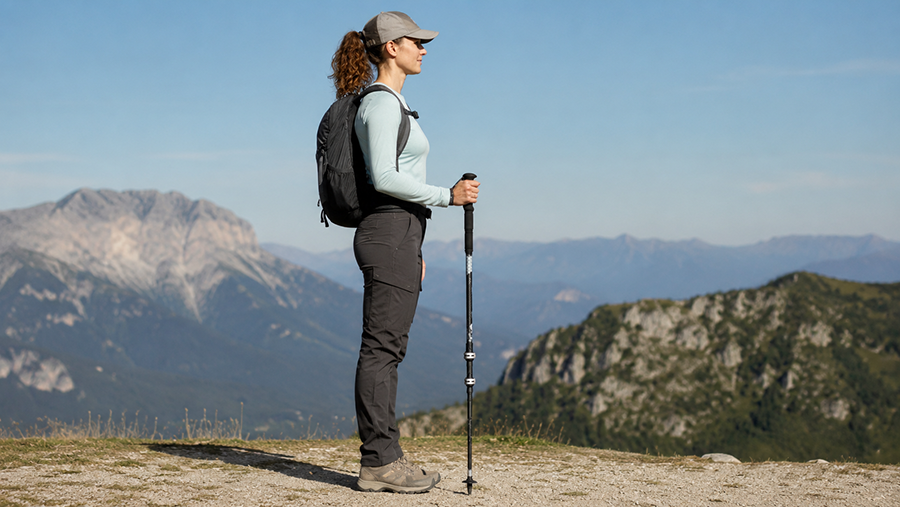
The level-ground setting is the base Working Length. The poles can then be adjusted according to the terrain.
| Terrain | Recommended Adjustment | Main Check |
|---|---|---|
| Level ground | Use the base length | Elbow near 90 degrees |
| Uphill | Shorten about 5–10 cm | Shoulders remain relaxed |
| Downhill | Lengthen about 5–10 cm | Pole Tips contact the ground ahead |
| Side slope | Use different pole lengths | Match the ground height |
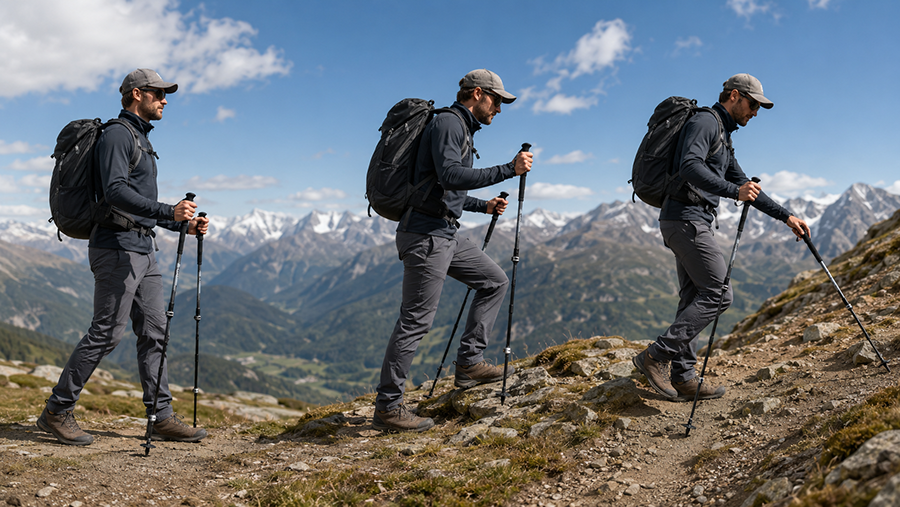
On uphill sections, shorter poles help prevent the arms from lifting too high. On downhill terrain, slightly longer poles provide earlier ground contact.
When crossing a side slope, shorten the uphill-side pole and lengthen the downhill-side pole. A Long EVA Foam Grip or Extended Grip can also allow the user to move one hand lower during short climbs without changing the shaft length.
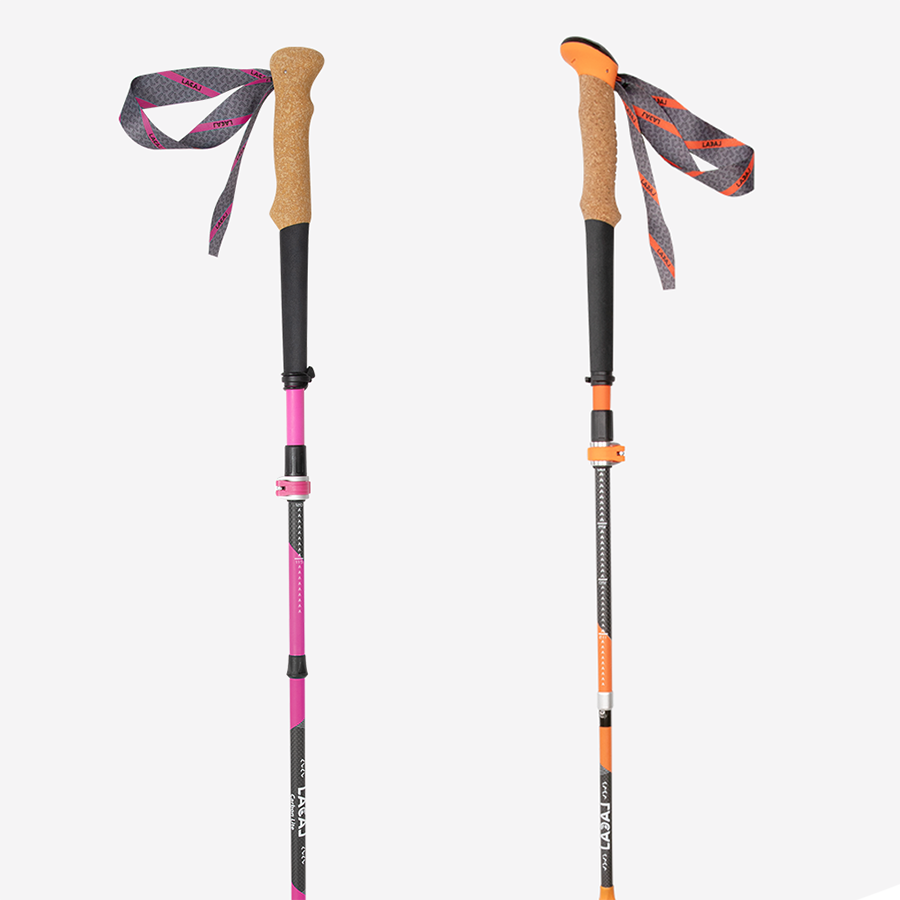
Adjustable Trekking Poles are suitable for changing terrain and different users. They include External Lock Trekking Poles, Internal Lock Trekking Poles, and Adjustable-Length Folding Trekking Poles.
Fixed-Length Trekking Poles are often used for trail running, consistent terrain, and lightweight designs. A Fixed-Length Folding Trekking Pole must be selected carefully because its Working Length cannot be changed after deployment.
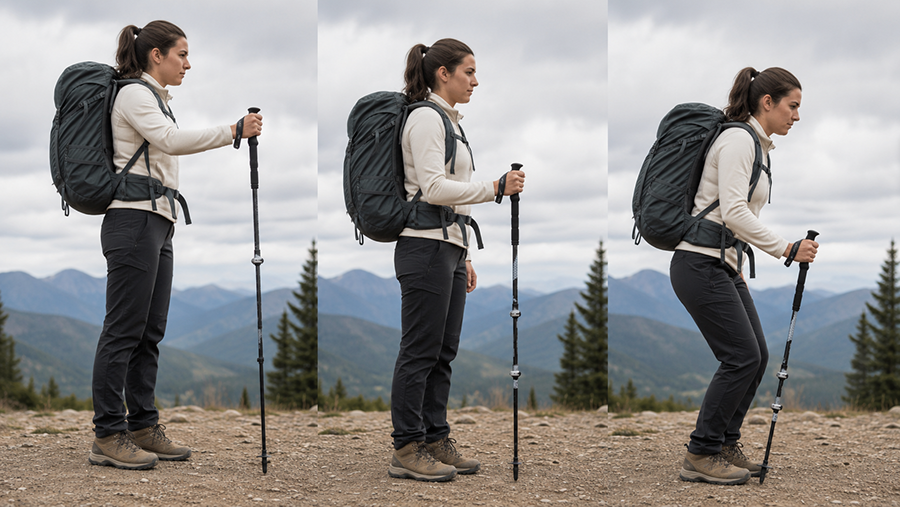
The effective pole length depends on where the hand holds the Grip.
Products with a Standard Grip, Long EVA Foam Grip, Extended Grip, Natural Cork Grip, or TPE Overmolding Grip may have different practical hand positions. The user should measure from the section normally held during walking rather than only from the top of the Grip.
The maximum marked length is not always the correct Working Length. Safe tube overlap and locking stability must always be maintained.
After setting the correct pole length, users can also review How to Walk with Trekking Poles for Grip, Wrist Strap, and walking technique guidance.
The final length should be tested through actual standing and walking rather than selected only from a height chart.
For outdoor brands, importers, distributors, and retailers, important product specifications include:
Packaging and product instructions can include a simple height chart together with guidance for level ground, uphill terrain, and downhill terrain.
Length-related inspection may cover finished pole length, scale accuracy, shaft dimensions, minimum tube overlap, repeated adjustment, Locking System stability, and Grip-to-shaft assembly.
Testing methods and acceptance requirements should be confirmed before mass production.
XATP provides OEM and ODM support covering Working Length planning, user height range development, telescopic and folding structures, Locking Systems, sample production, length scale printing, aluminum tube processing, carbon fiber production, assembly, quality inspection, and packaging instructions.
Outdoor brands and professional buyers can review XATP’s Custom Trekking Pole OEM and ODM Services for additional project information.
A trekking pole should generally keep the elbow close to 90 degrees on level ground without raising the shoulder.
Shorten the poles for uphill terrain and lengthen them for downhill terrain. Height charts provide a useful starting point, but the final setting should be confirmed through actual posture, Grip position, terrain, and walking technique.
Manufacturing, R&D and production support for global trekking pole projects.


