


XATP 2025 Ultra Light Running Poles
October 19, 2025
 0574-65288269
 sales@ningbocomo.com


Using Trekking Poles properly is not simply about placing two poles on the ground while walking. Effective technique combines a relaxed grip, correct Wrist Strap use, natural arm movement, controlled Pole Tip placement, and adjustments based on terrain.
For normal hiking, the poles should complement the walking motion rather than force the body into a fixed pattern.
Before walking, check that the trekking poles are ready for use.
Make sure:
The poles should feel secure before the hike begins.
Adjustment prepares the equipment, but walking technique determines how the poles perform on the trail.
Hold the Grip naturally rather than squeezing it continuously.
Keep the fingers relaxed and the wrist in a comfortable, neutral position. The shoulders should also remain relaxed as the arms move.
A natural grip can help:
Grip design also affects the way a trekking pole feels in the hand.
Common materials include EVA Foam, cork, and TPE. Some models also use an Extended Grip, allowing the user to temporarily change hand position without readjusting the entire pole.
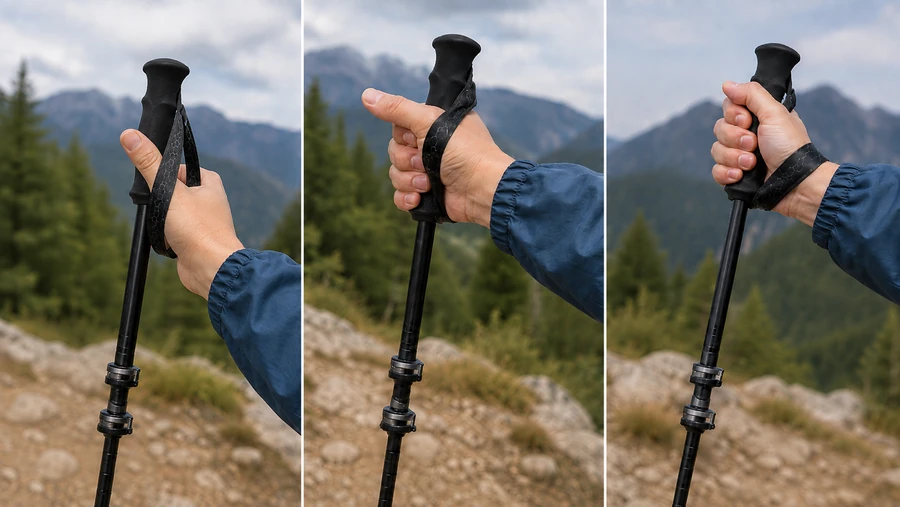
Wrist Straps help connect the hand to the pole and can reduce the need to squeeze the Grip continuously.
A common method is:
When correctly adjusted, the Wrist Strap can help:
Wrist Strap structures vary between products, so the specific product instructions should also be followed.
On normal terrain, two trekking poles are commonly used with an alternating walking rhythm.
A typical pattern is:
This follows the natural opposite-arm movement used during walking.
The movement should remain relaxed rather than mechanical. Walking speed, terrain, obstacles, and personal comfort may require the rhythm to change.
Key Point: Avoid trying to force every step into an exact sequence. Keep the shoulders relaxed and allow the arms to swing naturally.

On relatively level terrain, the Pole Tip is generally placed beside or slightly ahead of the body.
The placement should provide support without interfering with the natural stride.
Avoid placing the Pole Tip:
The correct position changes slightly with terrain, but the Pole Tip should always contact a stable point that allows smooth forward movement.
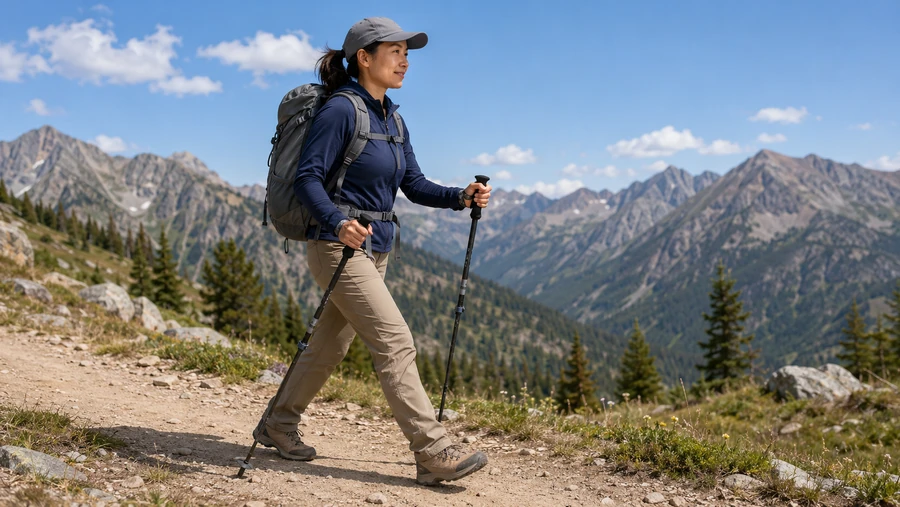
When walking uphill, pole movements usually become shorter and more compact.
The Pole Tips can be placed slightly forward to support the next movement and maintain rhythm.
Useful techniques include:
The poles should support the walking motion rather than become the main source of propulsion.
During a descent, the Pole Tips can be placed slightly ahead to provide additional support and control.
Keep the movements controlled and avoid reaching excessively far forward.
Before descending, check that the Locking Systems remain fully secured.
The goal is to maintain stable contact while continuing to move naturally rather than placing excessive downward force on the poles.
On rocks, roots, gravel, mud, or snow, a fixed walking rhythm may not always be practical.
Pole placement should instead respond to the available secure contact points.
On uneven terrain:
The correct Basket, Pole Tip, and Tip Pad configuration can be just as important as walking technique.
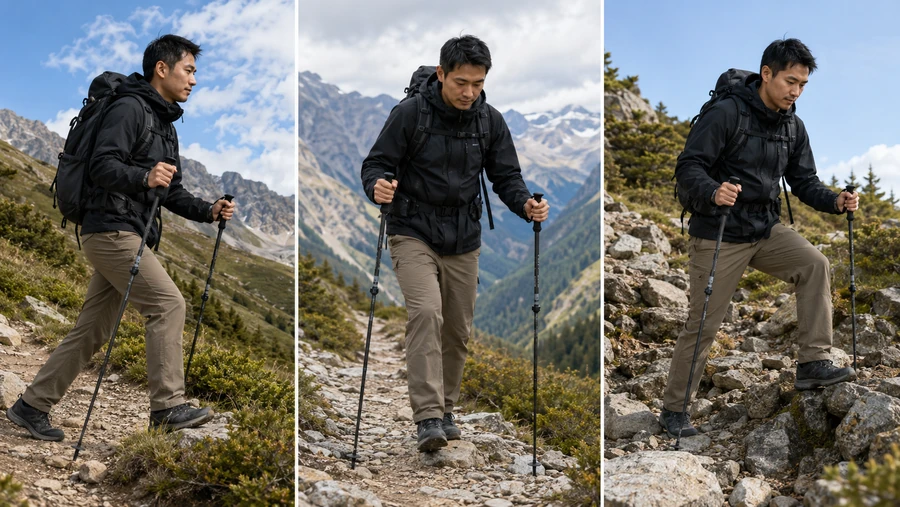
Two trekking poles are generally better suited to continuous hiking because they provide support on both sides and allow a more balanced alternating rhythm.
One trekking pole may be useful when:
The better configuration depends on the activity, terrain, and intended use.
Good technique should adapt to the trail rather than force the user into one fixed movement pattern.
Efficient trekking pole technique usually relies on small, controlled movements rather than large arm swings.
Try to:
Key Point: Good trekking pole technique should feel natural rather than forced.
The way a trekking pole performs during walking depends on more than its Working Length.
Important product features include:
These factors influence how easily the user can control the pole, change hand position, place the Pole Tip, and maintain a natural walking motion. Product structure also matters: compact Folding Trekking Poles may prioritize portability while still requiring suitable Grip, Wrist Strap, shaft, and Locking System design for practical use.
For brands, importers, distributors, and retailers, trekking pole development should consider how the entire product structure supports actual use.
Important factors include:
Key Point: A trekking pole should not only meet dimensional specifications. Its Grip, Wrist Strap, shaft balance, adjustment system, and accessory configuration should also support practical and natural walking technique.
XATP supports OEM and ODM trekking pole development for different markets, activities, and product positioning requirements.
Available customization options include:
Brands, importers, distributors, and retailers can review XATP’s Custom Trekking Pole OEM and ODM Services for additional project information.
To use trekking poles properly, hold the Grips lightly, use the Wrist Straps correctly, coordinate the poles with a natural walking rhythm, and place the Pole Tips where they provide stable support without interrupting the stride.
Different terrain may require different pole placement, rhythm, and accessory configurations.
The objective is not to force the body into a fixed movement pattern. Trekking poles should complement natural walking and provide controlled support throughout the hike.
Manufacturing, R&D and production support for global trekking pole projects.


