


XATP 2025 Ultra Light Running Poles
October 19, 2025
 0574-65288269
 sales@ningbocomo.com


Carbon Trekking Poles usually cost more than aluminum models, so the key question is whether the lower weight and handling advantages justify the higher price.
For hikers who prioritize lower weight, quick pole movement, and a stiffer shaft feel, Carbon Fiber trekking poles can be worth the investment. For general hiking, budget-focused users, or conditions where frequent impacts are expected, aluminum may offer better overall value.
The better choice depends on how the poles will be used, not simply on which material sounds more premium.
Carbon Fiber and aluminum shafts behave differently in real-world use.
| Feature | Carbon Fiber | Aluminum |
|---|---|---|
| Weight | Usually lighter | Usually heavier |
| Shaft Feel | Stiffer and responsive | More flexible |
| Impact Behavior | Can crack, split, or delaminate | More likely to dent or bend |
| Vibration | Often lower | Usually more noticeable |
| Price | Usually higher | Usually lower |
| Structural Damage | Damaged shaft normally replaced | Bent section normally replaced |
| Typical Positioning | Lightweight / premium | General hiking / value-focused |
Neither material is automatically better. A well-designed aluminum pole can provide excellent durability and value, while a properly engineered Carbon Fiber pole can be more attractive for users focused on reducing weight and improving swing feel.
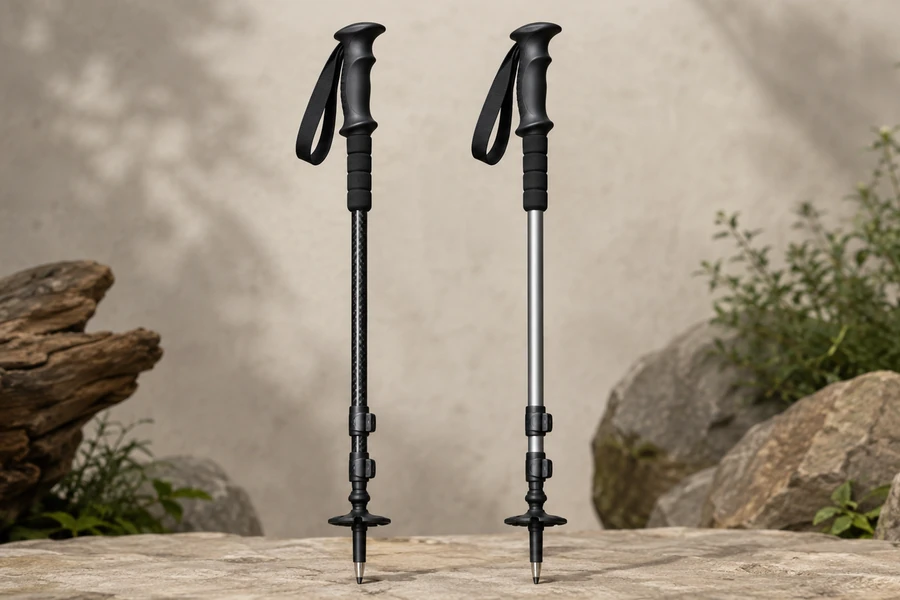
Carbon Fiber is commonly selected because of its high strength-to-weight potential, but finished pole weight depends on much more than the shaft material.
Important factors include:
A lightweight Carbon Fiber shaft can still become part of a relatively heavy finished pole if the Grip, Locking System, joints, and accessories are heavy.
Key Point: Carbon Fiber does not automatically mean ultralight. The complete pole structure should be evaluated.
Many users choose Carbon Fiber because of how it feels during repeated pole movement.
Potential advantages include:
These characteristics can become more noticeable during long hikes or activities involving frequent pole swings. However, feel is partly subjective, and some users prefer the slightly more flexible response of aluminum.
Durability is more complicated than asking which material is stronger.
Carbon Fiber can provide high stiffness and strength under its intended loading conditions, but certain impacts may cause cracking, splitting, delamination, or crushing.
Aluminum behaves differently. After a strong impact, the shaft may dent or bend instead of cracking.
This difference matters because aluminum deformation is often easier to see, while Carbon Fiber damage may extend beyond the visible surface. Neither material should be considered indestructible.
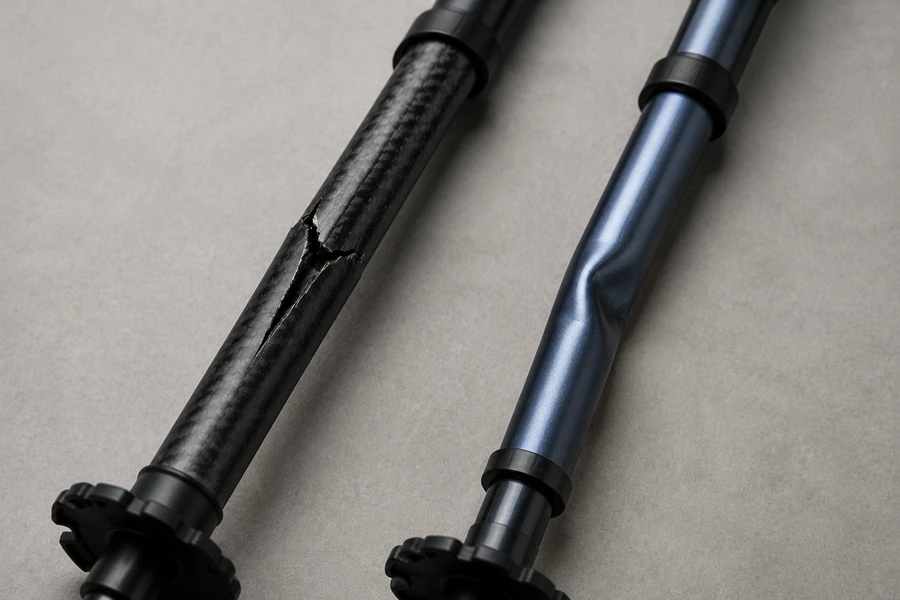
A cracked Carbon Fiber shaft should normally be replaced.
Tape, adhesive, or other temporary wrapping may hold the damaged surface together, but it does not restore the original structural performance of the shaft.
Stop using a Carbon Fiber section if you see:
For a load-bearing trekking pole, replacement is generally more appropriate than an improvised structural repair.
Carbon trekking poles can be especially attractive for long-distance hikers.
During a long hike, the user repeatedly lifts, swings, plants, and retrieves the poles. Lower pole weight and lower swing weight may therefore become more noticeable over time.
Carbon Fiber is particularly relevant for:
That does not mean every long-distance hiker needs Carbon Fiber. Grip comfort, Wrist Strap design, Locking System reliability, and overall pole ergonomics remain equally important.

Not necessarily.
Rocky terrain can expose trekking poles to side impacts, hard surface contact, and accidental trapping between rocks.
Carbon Fiber can still perform well in mountain environments, but buyers should also consider:
For users who expect frequent impacts or prioritize lower replacement cost, aluminum may be the more practical choice.
A Folding Trekking Pole includes much more than the shaft material.
Its final weight and performance also depend on:
A Full Carbon Fiber Folding Trekking Pole is therefore not automatically the lightest or best-performing option. The entire structure should be evaluated as one system.
Not every premium trekking pole needs a Full Carbon Fiber shaft.
Full Carbon Fiber structures are commonly selected when lower weight and premium positioning are priorities.
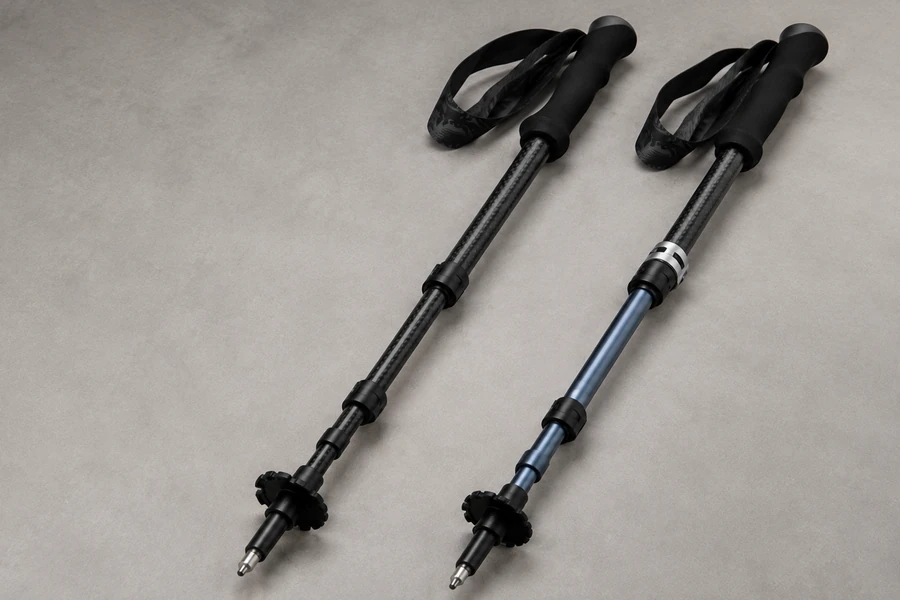
A hybrid design combines Carbon Fiber and aluminum sections.
This can help balance:
For some products, a hybrid structure may offer a better overall balance than using one material throughout the entire shaft.
No. A higher price does not automatically mean better overall performance.
A Carbon Fiber trekking pole should also be evaluated by:
Premium shaft material cannot compensate for weak component or structural design.
Carbon trekking poles may be worth the additional cost for:
For these users, lower weight and handling characteristics may justify the higher price.
Aluminum may remain the better choice for:
Aluminum is not simply a lower-grade alternative. It serves a different product positioning and use case.
For brands, importers, distributors, and retailers, shaft material should be selected according to the target product rather than treated as a standalone selling point.
Important factors include:
For B2B Product Development: a lightweight premium trekking pole and an entry-level general hiking pole may require completely different material strategies.
XATP supports OEM and ODM Trekking Pole Development for different Carbon Fiber and hybrid trekking pole structures.
Available development options include:
These options allow shaft material, product structure, weight, components, and market positioning to be developed as one complete product system.
Carbon trekking poles can be worth the extra cost when lower weight, responsive handling, and premium product positioning are important.
They are particularly attractive for long-distance hikers, lightweight backpackers, trail runners, and users who place a high value on reduced pole weight.
Aluminum remains a strong option for general hiking, price-sensitive products, and applications where impact exposure and replacement cost are important considerations.
The best trekking pole is not determined by shaft material alone. Carbon Fiber or aluminum should be selected together with the pole structure, components, terrain, target user, and overall product positioning.
Manufacturing, R&D and production support for global trekking pole projects.


