


XATP 2025 Ultra Light Running Poles
October 19, 2025
 0574-65288269
 sales@ningbocomo.com


Trekking Poles can usually be taken on a flight, but the safest and most predictable option is to pack them in checked baggage.
Carry-on rules vary by country, airport, airline, transit point, and Pole Tip design. Even when a pole appears to comply with published guidance, airport security personnel may make the final decision at the checkpoint.
Important: Airline and airport-security rules must always take priority. Check the requirements for the airline, departure airport, transit airport, destination airport, and return journey before traveling.
In most cases, trekking poles can travel by air when they are packed correctly.
The main issue is whether they may be taken into the cabin or must be placed in checked baggage. Poles with exposed or pointed tips are more likely to be restricted in carry-on luggage.
For the lowest-risk approach:
| Packing Method | General Recommendation |
|---|---|
| Carry-on baggage | Rules vary; confirm in advance |
| Checked baggage | Usually the safest option |
| Attached outside a suitcase | Avoid unless fully protected |
| Medical walking aid | May follow different procedures |
Checked baggage is generally more practical because trekking poles may include Tungsten Carbide Tips, metal shaft sections, Baskets, and Locking Systems that could trigger additional inspection.
A pole accepted on the outbound journey may still be restricted at a transit or return airport. One airport’s decision should not be treated as a universal rule.
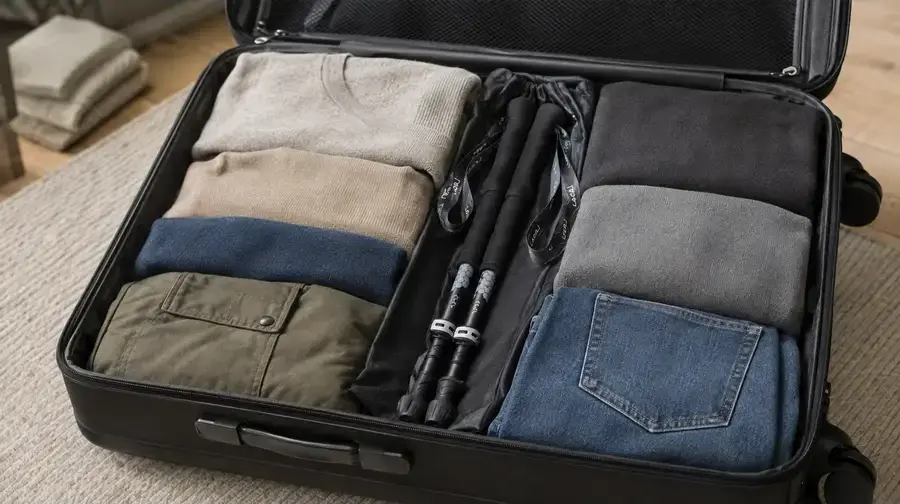
Collapse Telescopic Trekking Poles to their shortest safe length.
For Folding Trekking Poles, disconnect or fold each section according to the product structure. Never force the shaft sections to bend while they are still locked together.
Install Tip Pads over the Pole Tips whenever available.
A protective sleeve, thick fabric, or another secure covering can also prevent the tips from damaging the suitcase or contacting baggage handlers during inspection.
Detachable Baskets may be removed when practical and stored separately.
Keep small accessories in a sealed bag so they do not move around or become lost inside the luggage.
Place both poles inside a Storage Bag before putting them in the suitcase.
Keeping the pair together reduces movement and helps protect the Wrist Straps, Locking Systems, Baskets, shaft surfaces, and Grip connections.
Wrap the poles with clothing or other soft travel items. Pay particular attention to:
Avoid placing heavy objects directly over these components.
Place the poles along a firm edge of the suitcase or between layers of clothing.
They should not move freely when the suitcase is lifted, turned, or handled. Excessive movement can damage the shaft finish, Locking System, or folding connections.
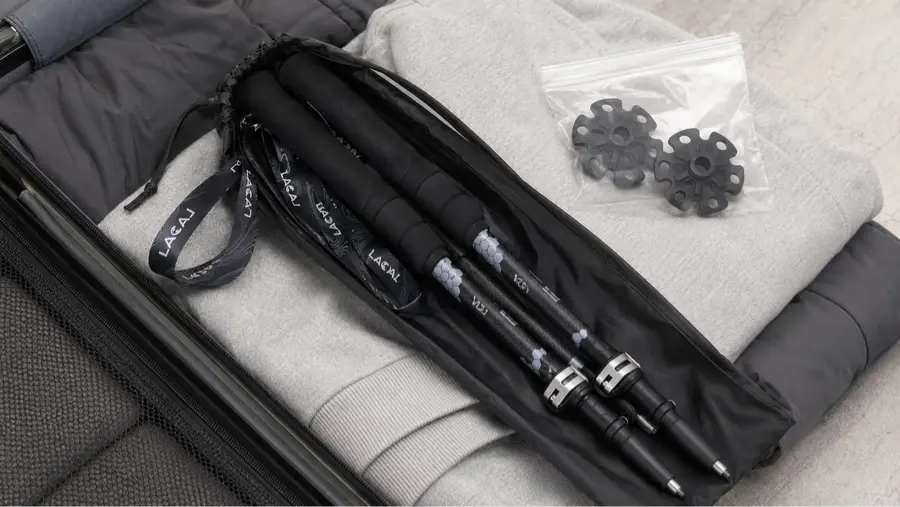
Pole Tips and Locking Systems require the most attention during air travel.
Use Tip Pads or protective sleeves so the tips do not press directly against the suitcase. If the poles use Tungsten Carbide Tips, make sure the protective covering cannot come loose during handling.
For External Lock Trekking Poles, close each lever before packing and avoid placing hard objects directly against the lever.
For Internal Lock Trekking Poles, shorten the sections securely without overtightening the mechanism.
For Folding Trekking Poles, protect the Folding Joint and Internal Cord. Do not pull the sections apart with excessive force, and do not place concentrated weight directly on the folded assembly.
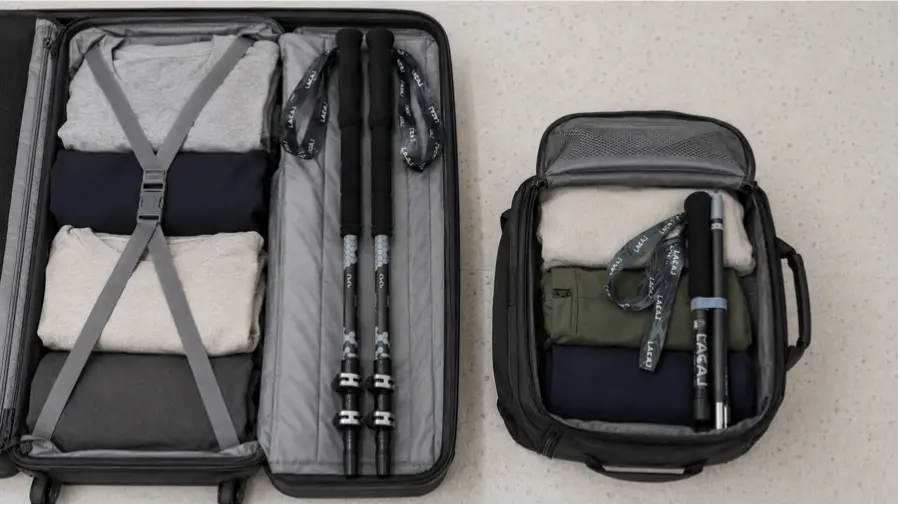
Telescopic models usually have a longer Packed Length.
Before packing:
These models are generally easier to pack in a medium or large checked suitcase.
Folding Trekking Poles usually offer a shorter Packed Length and can be easier to fit inside luggage.
Before packing:
Compact storage makes Folding Trekking Poles particularly suitable for frequent travel, but the joints still require careful protection.
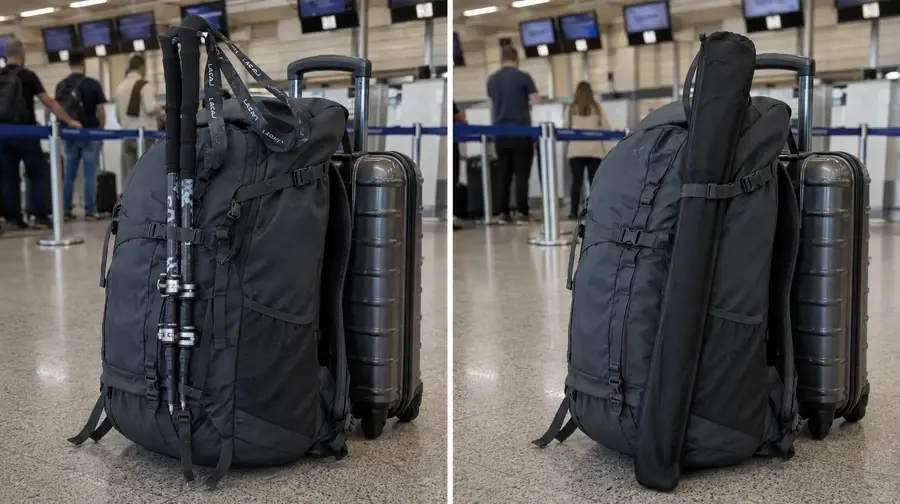
Attaching trekking poles outside a backpack may be convenient while hiking, but it is not recommended when checking the backpack for a flight.
Exposed components may become caught in baggage-handling equipment, including:
Place the poles inside the backpack whenever possible or use a protective travel cover. When internal storage is not possible, secure the poles tightly, cover the tips, remove loose accessories, and wrap the complete backpack before check-in.
Before departure, confirm:
Rules may differ between outbound and return journeys. Check every airport in the itinerary rather than relying only on the airline’s general policy.
Published rules are not identical across countries. Some authorities distinguish between blunt and pointed hiking poles, while others generally require walking or hiking poles to be placed in checked baggage. The airline and airport-security decision for the specific journey remains controlling.
When trekking poles are rejected at security, possible alternatives may include:
Do not discard valuable poles immediately. Ask airport staff whether you may leave the security area and return to the check-in counter.
Avoid these common mistakes:
XATP provides OEM and ODM support for travel-oriented Telescopic and Folding Trekking Poles.
Available project options include:
These options allow outdoor brands, importers, distributors, and retailers to develop trekking poles suited to air travel, compact storage, and different hiking applications.
Professional buyers can review XATP’s Custom Trekking Pole OEM and ODM Services for additional project information.
The safest way to carry trekking poles on a flight is usually to place them in checked baggage.
Collapse or fold the poles completely, cover the Pole Tips, secure detachable accessories, protect the Locking System, and prevent movement inside the luggage. Before traveling, confirm the requirements of the airline, departure airport, transit airport, destination airport, and return journey.
Manufacturing, R&D and production support for global trekking pole projects.


